
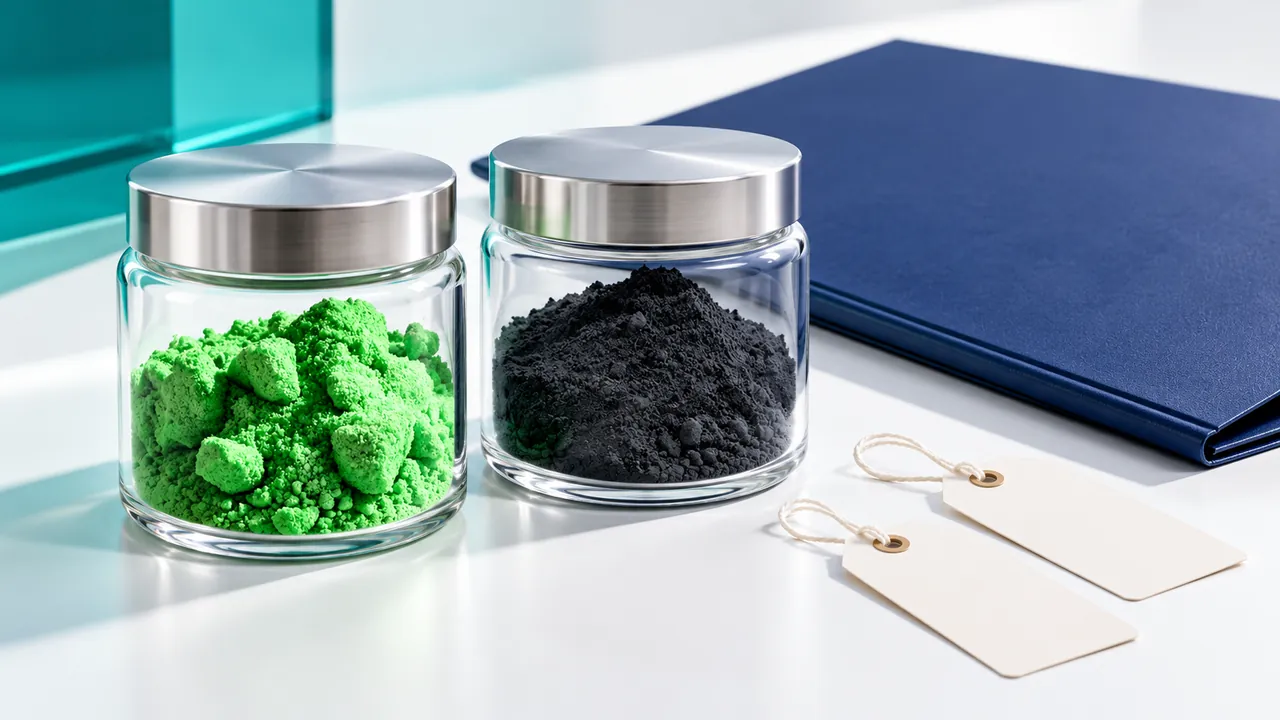
Nickel and cobalt are element names, not complete specifications for the compounds offered in an industrial catalogue. A buyer may encounter carbonates, sulfates, oxides and other forms, with different content statements and qualification needs. The first purchasing decision is to identify the actual material, not to rank several listings under a single metal name.
This guide follows the questions that make a grade-selection enquiry precise: compound identity, hydration or oxide phase, metal-content basis, impurities, documents and the intended downstream use. It provides no synthesis recipe, processing conditions or operating recommendation. Technical evaluation and handling belong with the responsible team and the supplied safety information.
Question one: which compound and form are required?
Record the complete product name, proposed model, chemical formula and relevant identifier as stated in the specification. Keep the original wording where the identity is unresolved and ask for clarification. Do not shorten a basic carbonate to an ordinary carbonate or remove a hydration statement to make a title easier to compare.
The same discipline applies to physical form. Powder, crystals and a solution proposal describe different offered forms. If a product title and technical sheet disagree, resolve the mismatch before deciding that either one represents the material to be supplied. A photograph can support an appearance description but cannot establish the compound identity.
Browse the nickel compound and cobalt compound groups as starting points. Each listing needs its own grade review. Membership in a metal-family collection does not make the listed compounds interchangeable for a purchasing or process requirement.
Question two: is hydration part of the identity?
For a salt described as hydrated, retain the hydration information in the material record. Ask which form is proposed, how it is identified in the supplied documents and which basis applies to the assay or metal-content figure. Do not transfer a specification from an anhydrous name to a hydrated offer without a documented review.
As examples of why full identifiers matter, Sigma-Aldrich lists nickel sulfate with hydration information and cobalt sulfate heptahydrate as specifically named products. These external examples illustrate naming practice; they are not specifications or evidence for a Relia Chemical shipment.
If the offered grade's documents use inconsistent formulas or hydration descriptions, make that an open identity question. Ask for the exact specification that will govern the sample and order. A plausible formula calculated from a broad trade name should not be inserted as a verified fact about the offered product.
Question three: which oxide phase is meant?
The phrase cobalt oxide can require further identification. PubChem provides separate records for cobalt(II) oxide, CoO, and cobalt(II,III) oxide, Co3O4. These are distinct formula descriptions. A broad colour or trade label should not be used to decide which phase an unidentified sample contains.
Ask which phase or composition statement applies to the actual grade and what evidence supports it. Keep that question separate from the total cobalt-content question. A metal percentage does not, on its own, establish all details of phase identity or mixture composition.
If a listing is deliberately broad because the phase is not yet established, preserve that uncertainty in the enquiry. Request the relevant TDS, SDS and analytical clarification before assigning a more specific name. Do not turn an unresolved description into a precise phase claim merely to make two catalogue rows look consistent.
Question four: does the percentage mean metal or compound?
Write the analyte beside every percentage. Nickel content, cobalt content and compound purity are different expressions and should not be placed under one undefined purity heading. Ask for the test method, units and reporting basis of the actual offered grade.
Clarify whether the result is expressed on the as-supplied material, a dry basis or another defined basis. For a hydrated salt, a basic salt, a mixture or an oxide proposal, the meaning of the percentage is especially important. Retain the source wording until the supplier and technical reviewer agree what it represents.
Separate a typical value from an acceptance limit and from a measured batch result. A high-looking number is not a complete grade-selection decision. The buyer must also establish identity, relevant impurities and the requirements of the downstream process.
A useful comparison row contains the parameter name, candidate value, unit, basis, method, status and source document. When one of those fields is missing, record the question. Do not calculate a new commercial purity claim from an incomplete formula or an assumed hydration state.
Question five: which impurities matter to your application?
Ask your technical team to define the actual impurity limits required. A broad industrial or battery-related label is not a complete impurity specification. List the analytes, limits, methods and detection or reporting information needed to support the decision, rather than accepting a generic statement that the material is suitable.
Different end uses may require different evidence. A ceramic-pigment enquiry, a surface-treatment enquiry and a battery-material enquiry should not inherit one another's qualification assumptions. State the intended use and the specific criteria in the RFQ so the proposed grade can be checked against them.
If a document reports only selected impurities, do not treat unreported entries as measured zero. Ask whether the missing results can be supplied or how the requirement will be assessed. The technical reviewer should decide whether an information gap prevents sampling, qualification or an order decision.
Question six: does the document set describe the same proposal?
Match the product name, grade and identifiers across the quotation, technical sheet, safety sheet and sample label. Record the document revisions and the sample or batch reference. If a generic sheet covers several forms, ask which entries apply to the offered option.
The SDS supports safety review; the TDS describes the grade; the COA should be read in relation to a particular batch or clearly stated representative scope. None of these names alone proves a particular purity, regulatory approval or downstream qualification. Read the content and identifiers, not just the document title.
Request clarification when an SDS formula, TDS title and quotation trade name point to different identities. Do not resolve the conflict by choosing the most convenient source. Keep the affected decision pending until the material can be identified consistently.
The documentation guide sets out a practical review sequence. Confirm which documents are available for the actual enquiry and which batch information would accompany an order. A representative analysis should not be presented internally as the result for a future shipment.
Question seven: what must the sample evaluation establish?
Define the decision before arranging the sample. Identify the control or current material, incoming checks, application tests and acceptance criteria. Ask the responsible team to specify which conditions must remain constant and how deviations will be recorded.
At receipt, retain the material identifier and label information with the document set. Clarify whether the sample represents a named grade, a particular batch or another proposed scope. A successful trial only supports a decision about the material tested within the recorded conditions.
Keep incoming chemical analysis separate from downstream observations. Matching a metal-content limit does not automatically establish every process or finished-product requirement. Conversely, an encouraging application result should not erase an unresolved identity or impurity question.
Use the sample evaluation record to connect these details. The purpose is a traceable qualification decision, without unsupported extrapolation to every nickel or cobalt compound in the catalogue.
Question eight: what exactly is included in the quotation?
After the technical scope is clear, record the net quantity, package, destination, trade terms, timing and required documents. Confirm sample arrangements separately where needed. A price for one supplied form should not be compared with another while ignoring the difference in the accepted material specification.
MOQ, availability, sample cost, lead time and payment terms need confirmation for the actual enquiry. Do not infer a universal commitment from a product page or a previous discussion about a different grade. Keep the quotation tied to the material identifier reviewed by the technical team.
Where the final proposal changes the grade, formula description or document revision after a trial, review the relevant qualification decision explicitly. The approval of one sample should not silently become approval of a differently identified offer.
A compact technical handover
Retain clarification replies with the original documents instead of replacing the source wording in place. Another reviewer should be able to see what was first offered, what was questioned and which response resolved it. That record helps distinguish a confirmed identity from an assumption that merely became familiar through repeated use.
Prepare one record for the proposed compound. Include full identity, form, hydration or phase questions, content basis, mandatory impurity criteria, document references, trial requirements and commercial scope. List accepted requirements, accepted deviations and unresolved points separately.
Give each unresolved point a clear owner and decision consequence. For example, missing phase evidence may prevent grade identification, while an unconfirmed package preference may affect only the quotation. This makes the next request more useful than a general demand for all available information.
To begin, send the actual listing URL and requirement using the procurement checklist, then contact Relia Chemical. Clear compound and grade questions help the discussion stay focused on evidence for the material you intend to purchase.